Search

Random Recipe

Proper Pasty Recipe

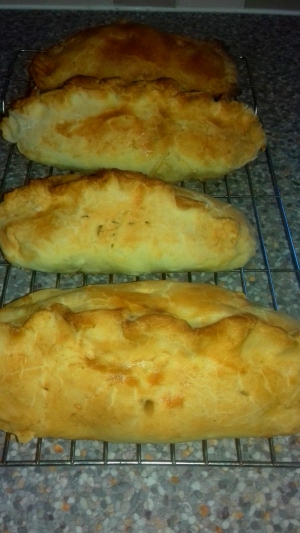
Proper Pasty RecipeOK it's not really a Cornish Pasty as Sue cooked it in York. But it's well worth the effort. Even if you're going to call it a Goole or Wetwang Pasty!
 
Ingredients for the filling:-
 
500g Beef, diced
Swede, Carrots and Parsnips, diced
2 Onions, diced
1 Baking Potato, diced 
1 tbls of fresh Thyme
Salt and ground Black Pepper
Paprika
 
Egg Wash:-
 
1 large beaten egg with 1 tbls of water
 
For the pastry:-
 
500g of bread Flour (Gluten free if required)
120g of Lard
1 tsp od Salt
25g of Margarine
175ml water
1 large Egg
 
Method:-
 
(1) In a large bowl add the flour and salt.
(2) Cut the Lard and Margarine into cubes and rub into the Flour aiming for a breadcrumb texture.
(3) Add the egg and stir in.
(4) Slowly add the water and knead.
(5) Turn out onto a floured surface and continue to knead.
(6) Roll out the pastry.
(7) Form into circles.
(8) Add the filling cold.
(9) Egg wash around the edges.
(10) Form your Pasties.
(11) Cook in the oven for 45 minutes at 180c or until the pastry is golden brown.
 
Few meals have roots as deep as the Cornish pasty. A hand-held meat-and-vegetable pie developed as a lunch for workers in the ancient English tin mines of Cornwall. With its characteristic semicircular shape and an insulating crust that does double duty as a handle. The humble pasty today receives special designation along with Champagne and Parma ham as a protected regional food by the European Union. 
 
The Cornish pasty descends from a broader family of medieval English meat pies. The earliest literary reference to pasties is likely from Chaucer’s “Canterbury Tales.” Legal records from 13th-century Norwich describe pastry-makers accused of reheating three-day-old pasties for sale as fresh. In London, a 1350 regulation barred cooks “On pain of imprisonment” from charging more than a penny for putting a rabbit in a pasty. These pasties were little more than cuts of meat wrapped in pastry dough. By then the Cornish pasty made from diced beef, potatoes, swedes and onions had already taken its place in Cornwall’s regional cuisine.
 
The Cornish pasty was a food for families, fishermen and farmers. But it shone in the darkness of Cornwall’s mines. Tin had been gathered in Cornwall since prehistoric times. Mining continued throughout the Roman and medieval eras and into the early modern period. For Cornish men heading underground, the pasty was a  highly efficient food: self-contained, self-insulated and packed with calories. The thick semicircular edge of the crust could be monogrammed with carved-dough initials or toothpick codes to make sure each man took the right pasty as he headed to the mines. The crust had an additional virtue: miners’ hands were often covered with arsenic-laden dust, so the crust could function as a disposable handle.

On Facebook

Chicken Maraq recipe from Oman

Our fictional trip around The World for £4 or less took us to Oman last night. This was one of our favourite recipes so far, with a new ingredient for us - Black Limes! These are dry preserved Limes which I found in the local Halal Continental shop. We only actually needed 2 but ended up with 500g. I can see these sneaking into all sorts of dishes. They really pack a citrus punch!
 
Ingredients:-
 
½ a small Chicken cut into portions – Drummer, thigh, wing, breast cubed etc.
A large knob of Butter or Margarine
1 Onion, chopped
2 cloves of Garlic, minced
Omani Spices (See below)
¼ of a tube of Tomato Paste
3 large Tomatoes, chopped
2 Black Limes, cut in half
1250 ml of Chicken Stock (We had our own in the fridge from the Chicken carcass Sue rended down a while ago – But Stock cubes are cool)
3 medium Potatoes, peeled and cubed
 
Omani Spices 
 
Ingredients:-
 
1 handful of chopped Coriander
Cumin
Cinamon
Black Pepper
Cloves
Turmeric
½ tsp of each dried ingredient.
 
Method:-
 
(1) Fry the Onion in the Butter / Margarine until golden and softened.
(2) Add the Chicken pieces and cook for a further 5 minutes.
(3) Add the Garlic, Omani Spices, Tomato Paste, chopped Tomatoes and Black Limes.
(4) Add the Chicken Stock and stir for 2 minutes.
(5) Add more water if the sauce seem too thick, but you are aiming for quite a thick sauce.
(6) Bring to the boil them simmer for 15 minutes.
(7) Add the Potato and simmer for a further 20 minutes until the Potato is softened but not breaking down.
 
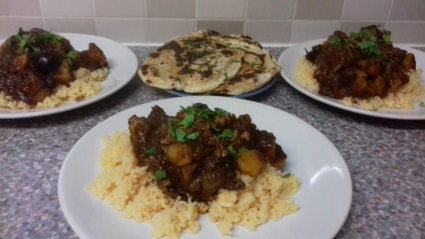
We enjoyed ours with hand made Gluten free flat breads (Recipe Here), Turmeric Rice and a sprinkling of chopped Coriander to add a bit of colour. 
 

Social Links

Translate

English French German Italian Portuguese Russian Spanish